Back to 2026 Abstracts
Decellularized Cartilage Reinforces Engineered Auricular Constructs to Preserve Shape and Volume In Vitro
Matthew W. Liao
*, Samuel Medina, Steven Danilav-Lee, Olivia H. Carrafiell, Paul Kim, Gabrielle Kupferman, Terrence C. Green, Xue Dong, Jason A. Spector
Weill Cornell Medicine, New York, NY
BACKGROUND: Microtia requires complex reconstruction typically using autologous cartilage or synthetic implants. However, these methods are limited by donor morbidity and non-physiologic stiffness. Tissue-engineered ear cartilage is promising, but hydrogel constructs often contract and lose topographic detail. We previously showed that chondrocyte-seeded collagen supports elastic cartilage formation
in vivo, while decellularized cartilage (DC) improves mechanical stability but lacks chondrogenic potential alone. We hypothesize that combining DC with chondrocytes in collagen matrix will enhance volume and shape retention
in vitro.
METHODS: Bovine auricular chondrocytes were isolated, expanded to passage 3, and encapsulated at 25 million cells/mL in 1% type I collagen with 0%, 30%, 60%, or 90% DC (100% collagen; 70/30; 40/60; and 10/90 collagen/DC). DC was derived from ovine rib cartilage processed into ~0.5 mm
3 flakes. Constructs in 3D-printed scaffolds were cultured for up to 3 months and assessed for volume retention and dome-base angle as a surrogate for shape preservation. Histology evaluated cell distribution and matrix deposition.
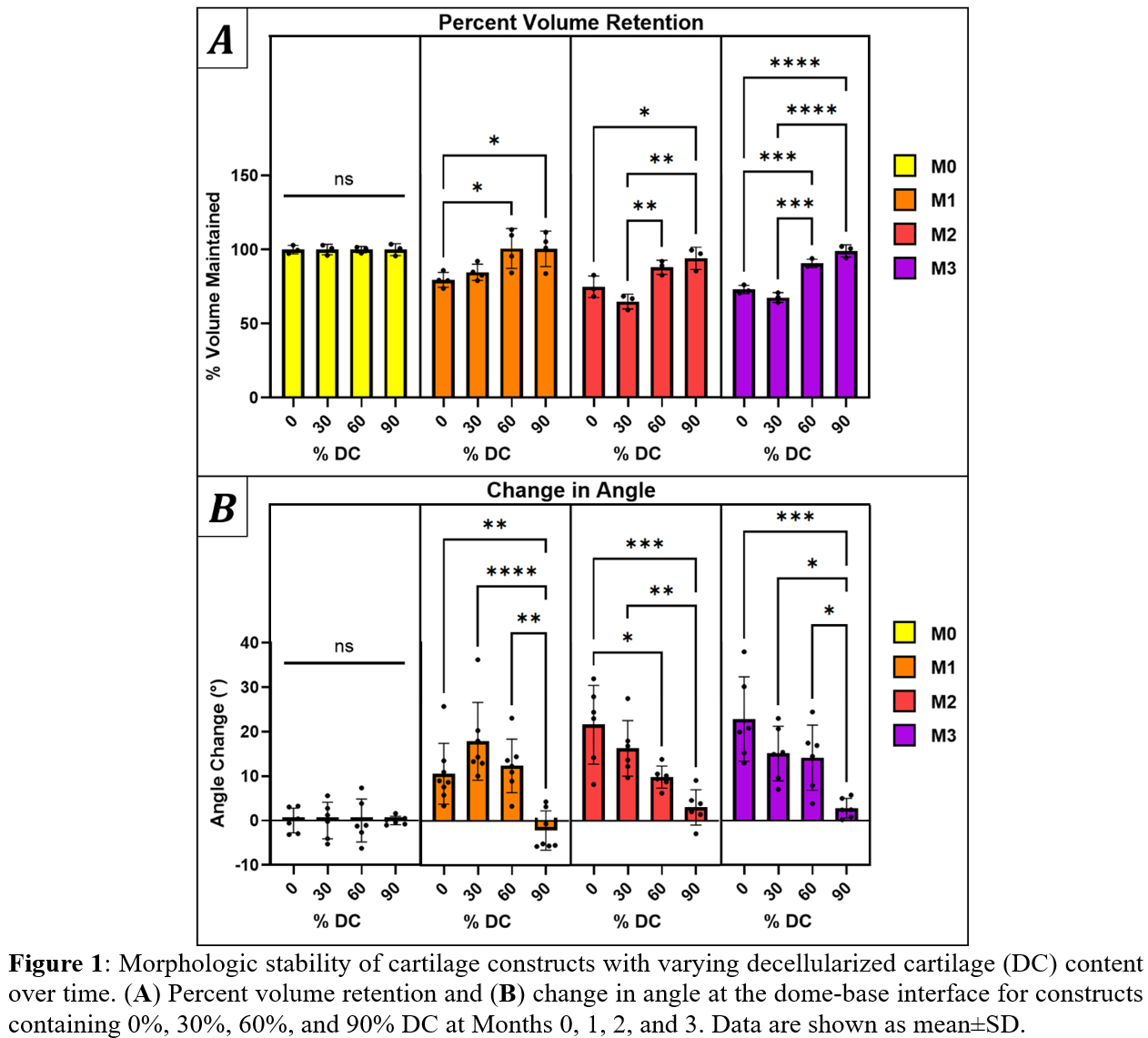
RESULTS: Constructs with higher DC content yielded significantly greater volume retention after 3 months
in vitro; volume retention was 98.96%±3.38% in 90% DC vs. 67.55±2.68% (30% DC) and 72.96%±2.31% (0% DC) (
p<0.0001). Angle measurements showed that higher DC preserved sharper dome-base curvature, while collagen-only constructs progressively flattened. Mean angle change was 2.79°±2.02° in 90% DC vs. 14.17°±6.70° (60% DC), 15.11°±5.60° (30% DC), and 22.85°±8.67° (0% DC) (
p<0.05). Histology confirmed viable chondrocytes throughout collagen matrix in all constructs; biomechanical testing is underway.
CONCLUSION: Incorporation of DC improves volume and shape retention in engineered auricular constructs without compromising cell viability, supporting its role as an internal rebar to resist contraction. This composite strategy represents a promising approach toward scalable, morphologically stable cartilage for microtia reconstruction.
Back to 2026 Abstracts


