Back to 2026 Abstracts
Clinically Meaningful Differences in Patient Reported Outcomes After Contralateral Prophylactic Mastectomy and Autologous Reconstruction
Jennifer Wang
*, Lillian A. Boe, Geoffrey Hespe, Francis D. Graziano, Evan Matros, Robert J. Allen, Jonas Nelson
Memorial Sloan Kettering Cancer Center, New York, NY
BACKGROUND: In patients with unilateral breast cancer, the decision to undergo a contralateral prophylactic mastectomy (CPM) weighs perceived oncologic risk against potential aesthetic and morbidity-related tradeoffs. Prior studies suggest comparable patient reported outcomes between unilateral and bilateral reconstruction; however, most compare postoperative median BREAST-Q scores without accounting for baseline values, potentially obscuring clinically meaningful differences. This study evaluates outcomes using a minimal clinically important difference (MCID)-based framework.
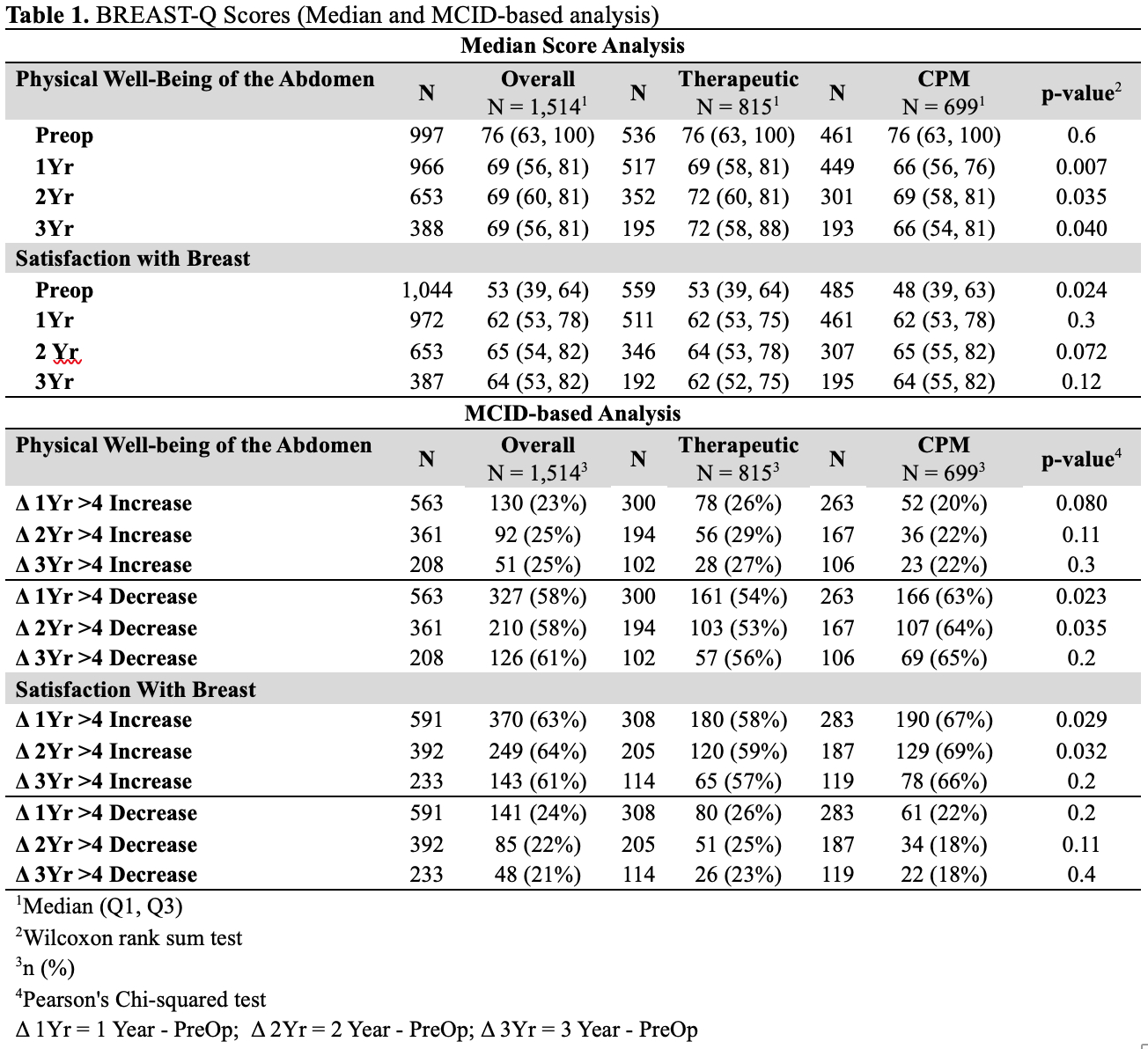
METHODS: A retrospective review was performed of 1,514 patients with unilateral breast cancer undergoing autologous reconstruction from 2017-2024. Patients were stratified by no CPM vs CPM. BREAST-Q scores in Physical Well-Being of the Abdomen and Satisfaction with Breast were assessed preoperatively and up to 3 years postoperatively. Changes from baseline were calculated, and the proportion of patients achieving MCID ≥4 was compared between cohorts.
RESULTS: Of 1,514 patients, 815 did not undergo CPM and 699 underwent CPM. Median BREAST-Q score analysis demonstrated worse postoperative abdominal well-being in CPM patients, with no differences in postoperative breast satisfaction. MCID-based analysis similarly showed that more CPM patients experienced clinically meaningful declines in abdominal well-being at 1 year (63% vs 54%, p=0.023) and 2 years (64% vs 53%, p=0.035) postoperatively. However, more CPM patients had improvements in breast satisfaction at 1 year (67% vs 58%, p=0.029) and 2 years (69% vs 59%, p=0.032). On multivariable analyses, CPM was independently associated with higher odds of worse abdominal well-being (OR 1.48, p=0.047) and improved breast satisfaction (OR 1.64, p=0.012).
CONCLUSION: Using a clinically meaningful framework, CPM in autologous reconstruction is associated with worsened abdominal well-being but improved breast satisfaction. MCID-based analysis reveals outcome differences not captured by median scores alone and may better inform patient-centered counseling.
Back to 2026 Abstracts


