Back to 2026 Abstracts
Investigating breast cancer risk reduction associated with breast reduction in patients with a family history of breast cancer: a nationwide propensity score-matched retrospective cohort study
Seungil Lee, Hannah D. Shi, BA, Theodore C. Lee, Agustin N. Posso, Chanthia Ma, Sarah Karinja, Bernard T. Lee
Beth Israel Deaconess Medical Center, Boston, MA
Background: Breast reduction may reduce breast cancer risk by removal of tissue that has the potential to undergo malignant transformation. This potential benefit has not been studied in patients with a family history of breast cancer who are more predisposed than the general population.
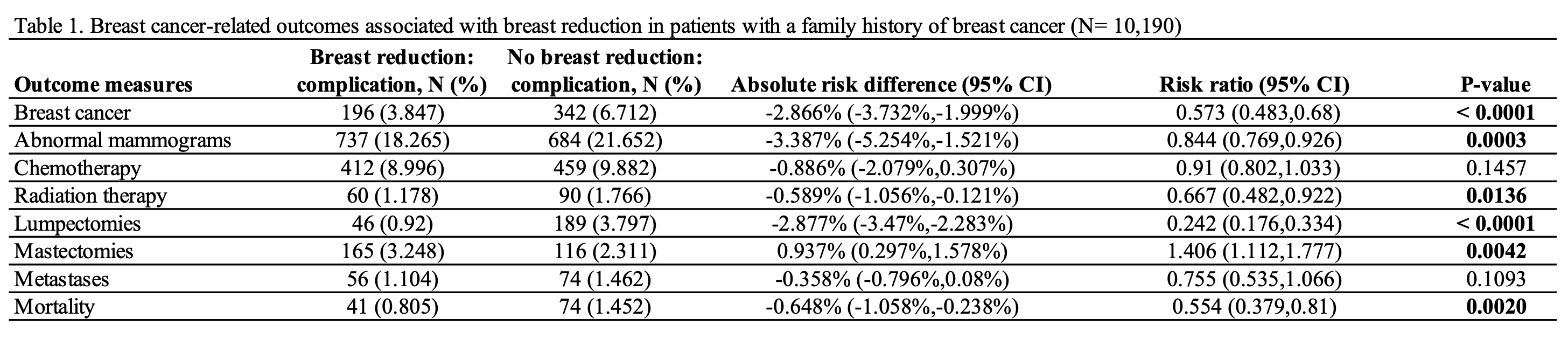
Methods: We identified patients with a family history of breast cancer and diagnosis of macromastia by leveraging the US Research Network of TriNetX, a large repository of electronic health records. Patients who underwent breast reduction within 6 months of their diagnosis of macromastia were then stratified into the exposure cohort; those who never underwent breast reduction qualified for the control cohort. Propensity score matching (1:1) was performed for demographic variables, comorbidities, medications, and body mass index classifications. Outcome measures of interest were incidents of breast cancer, abnormal mammograms, chemotherapy, radiation therapy, lumpectomies, mastectomies, metastases, and mortality assessed at 5, 10, and 15 years of their macromastia diagnosis. Patients with records of a given outcome measure prior to follow-up were excluded in the assessment of that outcome measure to reduce confounding by preexisting conditions.
Results: After matching, 5,095 patients were enrolled in each cohort. At year 15, patients who underwent breast reduction were at significantly lower risks of breast cancer (risk ratio [RR] 0.573, P-value [P] < 0.0001), abnormal mammograms (RR 0.844, P 0.0003), radiation therapy (RR 0.667, P 0.0136), lumpectomies (RR 0.242, P < 0.0001), and mortality (RR 0.554, P 0.0020). However, they were at a significantly higher risk of mastectomies (RR 1.406, P 0.0042). These effects were relatively preserved at the earlier timepoints.
Conclusion: Patients with a family history of breast cancer who underwent breast reduction for macromastia were at significantly lower risk of breast cancer.
Back to 2026 Abstracts


