Back to 2026 Abstracts
Do conventional or biologic DMARDs impact outcomes after body contouring procedures?: A national propensity matched analysis
Sophia Ahn
*, Anirudh Kulkarni, Bradley Colarusso, John B. Park, Ryan P. Cauley
Beth Israel Deaconess Medical Center, Boston, MA
Introduction
Most autoimmune disease (AD) patients receive conventional disease-modifying antirheumatic drugs (cDMARDs). Meanwhile, biologic DMARD (bDMARD) use is continually increasing in AD patients. This is the first large database study examining whether cDMARDs and bDMARDs confer higher risk of acute and long-term postoperative complications following body contouring procedures (BC). A sub-analysis compared outcomes between patients who use cDMARDs vs. bDMARDs.
Methods
We identified adults in TriNetX with ADs (rheumatoid arthritis, inflammatory bowel disease, lupus, etc.) who underwent abdominoplasty, panniculectomy, or breast reduction, with or without bDMARD or cDMARD use within 6 months prior to surgery. Patients were propensity-score matched based on demographics and comorbidities (specific AD, BMI, smoking, irradiation, neoplasms, etc.). Acute outcomes (within 90 days) included wound dehiscence, hematoma, infection. Long-term outcomes (within 5 years) included return to OR for revisions, re-explorations, aesthetic dissatisfaction warranting revisions.
Results
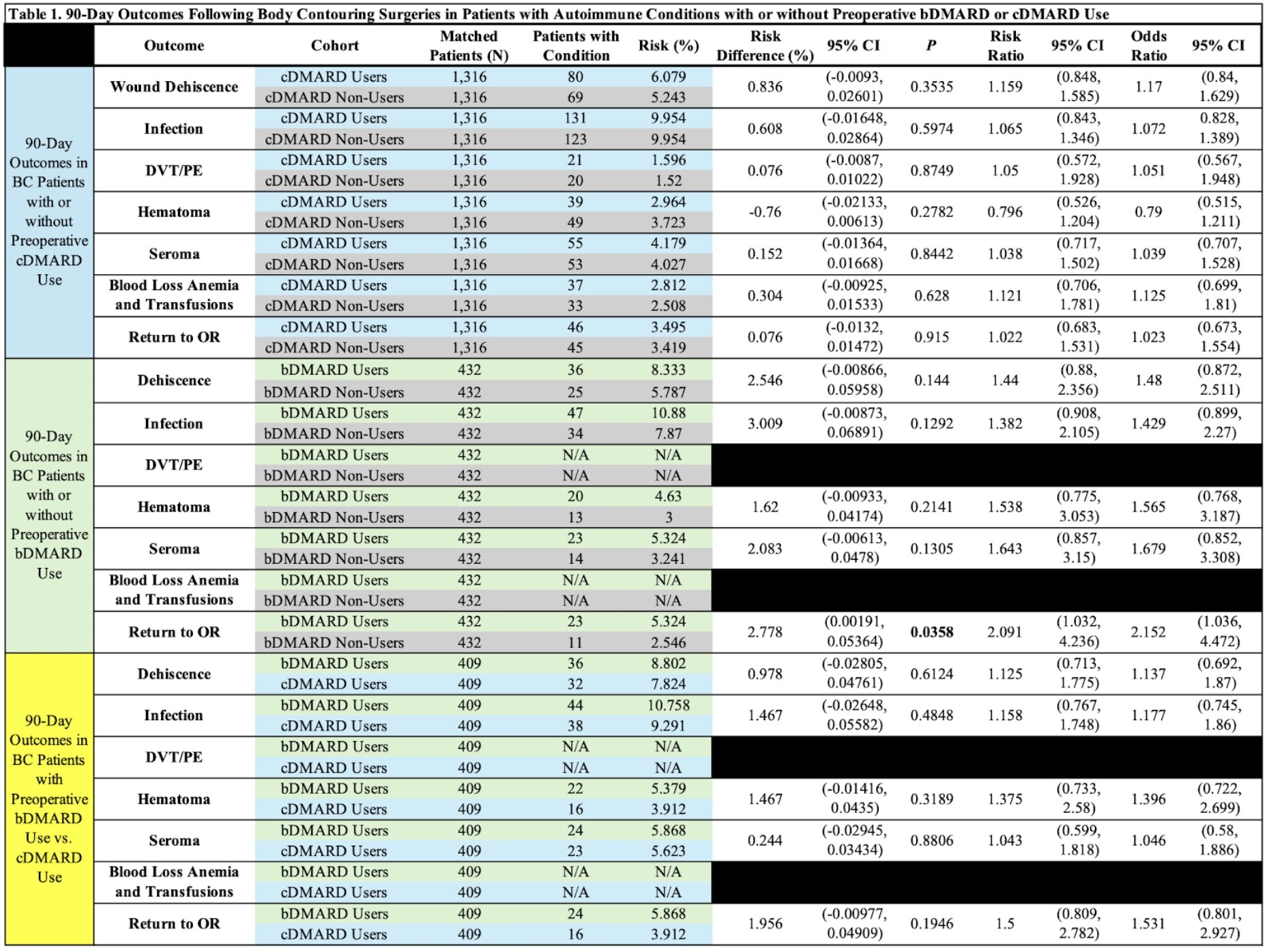
We identified 1541 BC patients with ADs and cDMARD use, 6941 with the same ADs and cDMARD use, 468 with ADs and bDMARD use, 9256 with the same ADs and no bDMARD use. There were 1316 matched cDMARD users and non-users, 432 matched bDMARD users and non-users, and 409 matched cDMARD and bDMARD users. No significant differences in any complications were found between the cDMARD and non-cDMARD cohorts. bDMARD users demonstrated modest, but significantly higher rates of OR return within 90 days (p=0.0358). No significant differences in any outcomes were found between the cDMARD and bDMARD cohorts.
Conclusions
The first large database study investigating whether DMARDs impact postoperative risk profiles in patients with ADs undergoing BC suggests that although cDMARD users may face slightly higher risk of OR return, DMARDs may not be completely contraindicative to undergoing BC. Further research is warranted on whether holding cDMARDs results in better postoperative outcomes.
Back to 2026 Abstracts


