Back to 2026 Abstracts
The Status of Medicaid Coverage of Gender Affirming Surgeries: A State-By-State Investigation
Sophia Ahn
1, Matthew Karofsky
*1, Anirudh Kulkarni
1, Harshita Pattam
2, Bradley Colarusso
1, Marrisa A. Kent
1, Ryan P. Cauley
11Beth Israel Deaconess Medical Center, Boston, MA; 2Boston University, Boston, MA
Introduction
The One, Big, Beautiful Bill Act prohibits federal Medicaid funding for gender affirming surgeries (GAS). Given that transgender and gender diverse adults are at greater odds of being publicly insured than private, we sought to determine 1) whether each Medicaid program covers GAS for adults
+ restrictions or prior authorization (PA), and 2) if an association exists between a state's LGBTQ+ legislative favorability (LF) and its coverage of GAS.
Methods
We placed calls to the 51 Medicaid provider support services within the same 2.5 weeks. We asked each questions about coverage of breast reduction (BR), mastectomy, breast augmentation (BA), vaginoplasty, phalloplasty, cricotracheal resection (CR), intersex procedures, and if there are restrictions or PA requirements. If unable to reach someone after calling back twice, we consulted official fee schedules. We performed a state-level cross-sectional analysis of all states, categorized by LGBTQ+ LF (favorable, unfavorable, neutral). Medicaid coverage was coded as present or absent. A chi-square test assessed the association between LF and coverage (statistical significance defined as p<0.05)
Results
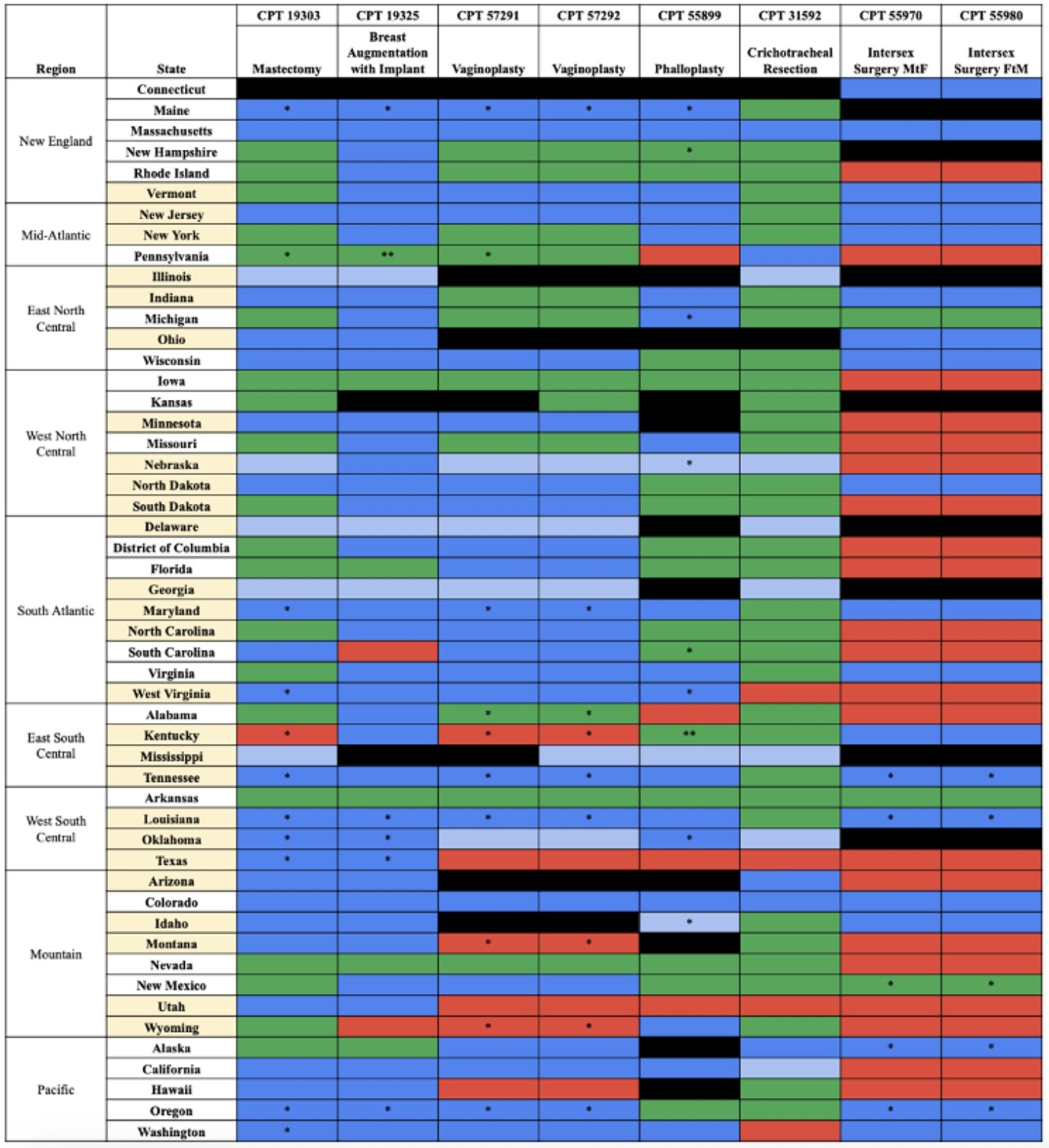
We spoke with 25 programs. Information on the remaining was obtained online. All cover mastectomy +/- PA, except KY (does not cover mastectomy for gender dysphoria [GD]). MD, WV, TN, LA, OR, WA require PA for mastectomy only for GD. All except SC, WY cover BA +/- PA. KY, TX, MT, UT, WY, HI do not cover vaginoplasty. Of the covering programs, MD, LA, TN, OR require PA if for GD. PA, AL, TX, UT do not cover phalloplasty. WV requires PA if phalloplasty is for GD. WA, UT, TX, WV do not cover CR while the remaining states do +/- PA. Medicaid coverage did not differ significantly by LF category (all p>0.05).
Conclusions
Variability in Medicaid coverage of GAS exists, with LGBTQ+ legislative favorability not being associated with the chance that a state covers any GAS. Further research should explore how these policies specifically impact Medicaid-enrolled TGD individuals and how these policies will change over time.

Models adjusted for BMI, tissue expander size, and axillary irradiation. OR > 1 indicates higher odds with early exchange.
Back to 2026 Abstracts

 Models adjusted for BMI, tissue expander size, and axillary irradiation. OR > 1 indicates higher odds with early exchange.

