Back to 2026 Abstracts
Transcriptomic Evidence Of Sympathetic Modulation Of Cells Involved In Peripheral Nerve Injury
Ife Shoyombo
*1, Dayal Rajagopalan
2, Rahul Gorijavolu
1, Kaushik Madapati
1, A Lee Dellon
1, Sami Tuffaha
11Johns Hopkins, Middle River, MD; 2Surgery, New York Medical College, New York, NY
PURPOSE: Peripheral nerve injury initiates complex regenerative programs involving Schwann cells, macrophages, fibroblasts, and endothelial cells. Sympathetic activity rises markedly after injury, yet its direct influence on the local repair microenvironment remains poorly defined.
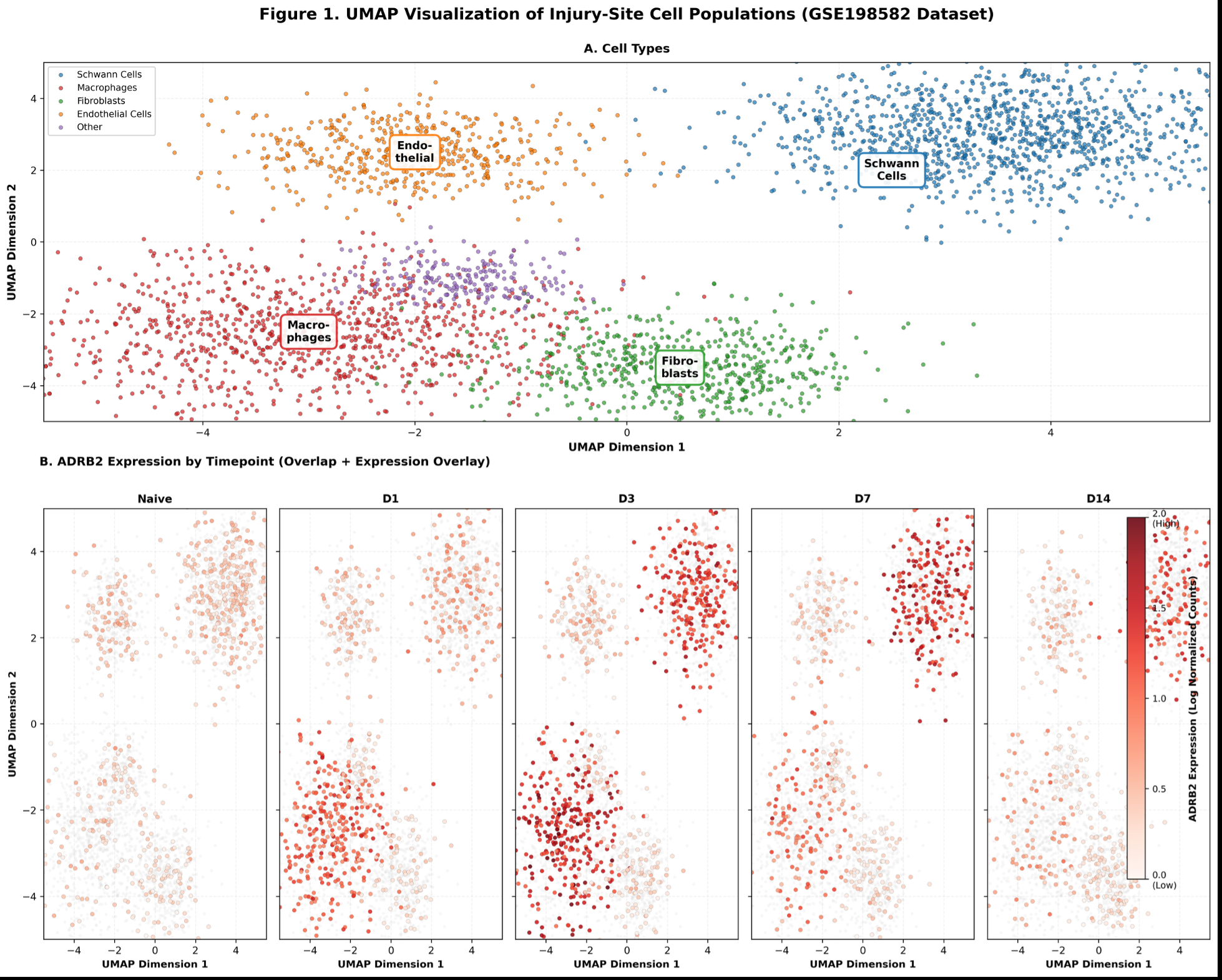
METHODS: We performed single-cell RNA sequencing (scRNA-seq) meta-analysis of two public datasets: (1) longitudinal mouse sciatic nerve crush injury (GEO: GSE198582) and (2) sympathetic/sensory ganglia transcriptomes (GSE175421). Using single-cell analysis, we profiled adrenergic receptor expression (α: ADRA1A/B/D, ADRA2A/B/C; Β: ADRB1/2/3) across cell types and timepoints (Days 0-14). Intercellular communication between sympathetic neurons and injury-site cells was inferred using NicheNet and CellPhoneDB v5.
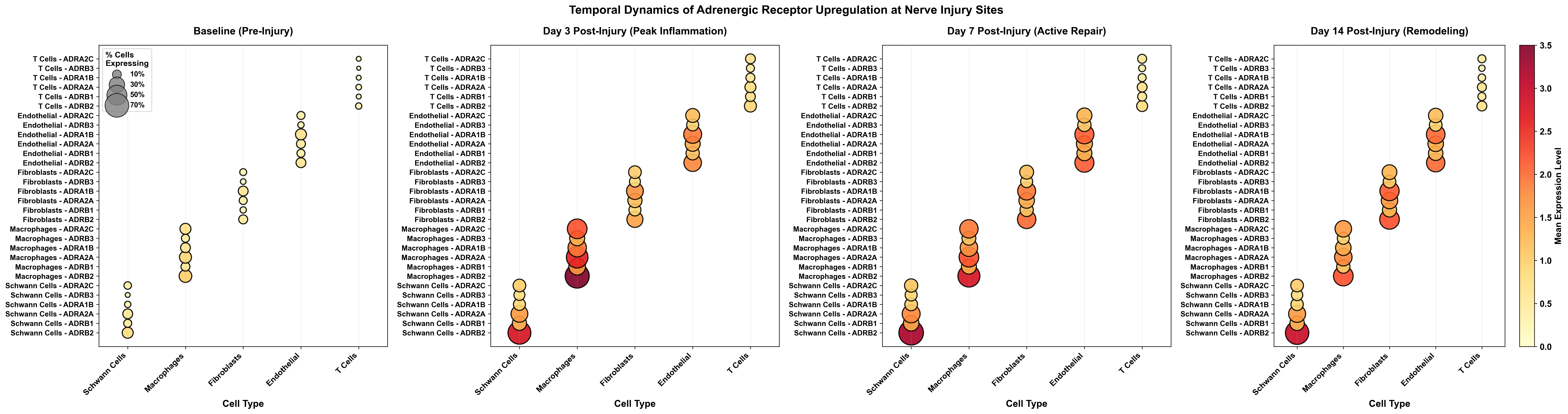
RESULTS: Adrenergic receptor expression was markedly increased following injury. ADRB2 (β2-adrenergic receptor) exhibited a 3-5-fold rise, with receptor-positive Schwann cells and macrophages increasing from 15-20% at baseline to 60-75% at Day 3 post-injury. Temporal profiling revealed biphasic activation: early receptor induction in macrophages (Days 1-3) corresponding to inflammatory influx, followed by sustained Schwann cell expression (Days 7-14) during remyelination. Fibroblasts preferentially upregulated ADRA1B, while endothelial cells showed mixed α/β receptor expression. Ligand-receptor mapping identified genes encoding catecholamine-synthesizing enzymes (TH, DBH, DDC) in sympathetic neurons as key senders driving downstream injury-site transcriptional responses.
CONCLUSION: Peripheral nerve injury elicits robust, time-dependent upregulation of adrenergic receptors in multiple cell types, establishing a molecular framework for sympathetic regulation of both inflammatory and reparative phases. These findings reveal adrenergic signaling as an important clinical target in nerve regeneration.
Back to 2026 Abstracts


